
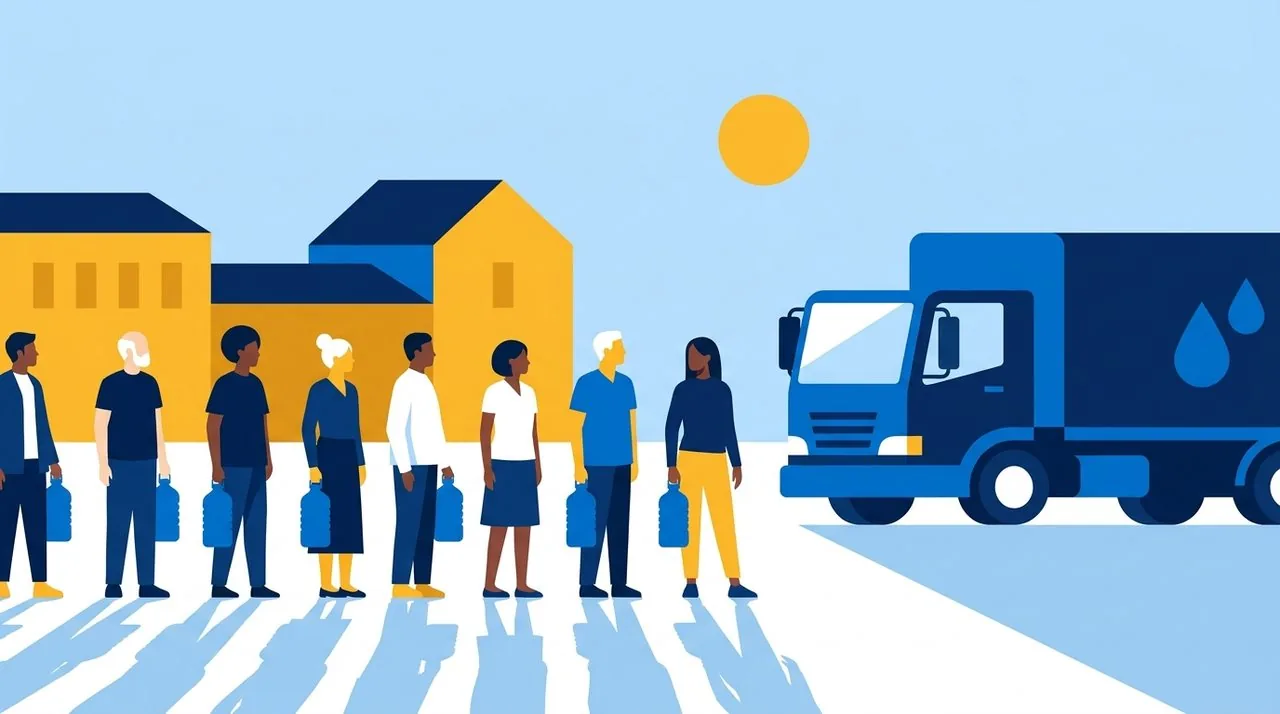
The summer heat turns the basic right to water into a daily ordeal for thousands of people in frontline communities.
July 2024 brought extreme temperatures to Ukraine. For most cities, this means an increased load on power grids, running air conditioners, and seeking coolness, but for the frontline communities of the east and south, the heat poses a direct threat to life. Destroyed pumping stations, kilometers of damaged main pipes, dried-up reservoirs, and de-energized local water pipelines have left entire districts without centralized water supply. In many settlements, the system has not functioned for months, and the only source of drinking water for tens of thousands of civilians remains delivered cisterns and bottled supplies from humanitarian initiatives.
According to experts, a person's minimum physiological need for water during the summer heat at least doubles. To this must be added the water required for basic sanitation and cooking. As a result, to provide for their families, people are forced to wait for hours every day for water trucks under the open sun. This process is physically exhausting, especially for the elderly, people with limited mobility, and families with children. It is precisely these categories of the population that make up a significant portion of those who, for various reasons, remain living near the line of contact, refusing or being unable to evacuate.
When the temperature crosses the thirty-degree mark, drinking water logistics becomes not just a matter of comfort, but the main survival tool for entire communities.Yellow-Blue Editorial Team
The Logistics Challenge and Invisible Threats
Infrastructure Collapse
Restoring stationary water pipelines is often impossible due to the constant danger to repair crews. Delivery by motor transport remains the only alternative to meet the basic needs of the population.
Sanitary Threat
The shortage of purified drinking water forces people to skimp on hygiene or seek alternative sources. During the summer period, this creates a favorable environment for outbreaks of infectious diseases.
The lack of stable access to clean water not only reduces the quality of life but also sharply increases sanitary and epidemiological risks. Consuming untested water from random sources, open wells, or technical reservoirs is extremely dangerous. According to medical experts, given the limited access to hospitals and pharmacies in frontline zones, even a local outbreak of an intestinal infection can quickly escalate into a serious crisis requiring immediate external intervention.
Delivering water to such zones is accompanied by a number of specific obstacles that make the process much more complicated than regular cargo transportation. Damaged road surfaces, destroyed bridges, and high fuel costs turn every trip into a challenge. Traditional supply routes often become inaccessible due to changes in the security situation, requiring an immediate reaction, the search for detours, and the creation of new distribution schemes. A water truck is a large vehicle that requires careful movement planning to minimize risks to civilians gathering at distribution points.
In addition to the transportation itself, organizing the process on the ground is a critical aspect. To avoid mass gatherings of people under the sun and reduce waiting times, it is necessary to accurately calculate consumption volumes for each street or block. Chaotic supply inevitably leads to uneven distribution: some locations receive a surplus, while other, more remote areas remain critically dehydrated. Synchronizing the arrival schedules of cisterns, setting up safe local distribution points, and maintaining constant communication with local residents are the invisible elements upon which the entire support system rests.
The Yellow-Blue Foundation is actively working to solve the problem of access to drinking water during the summer period. Our team focuses its efforts on optimizing logistics routes to ensure the fast and transparent distribution of this vital resource to the most affected communities. Thanks to a thorough analysis of local needs and the coordination of trips, we help optimize supply schedules, minimize waiting times for local residents, and guarantee that clean drinking water reaches exactly where it is critically needed.