
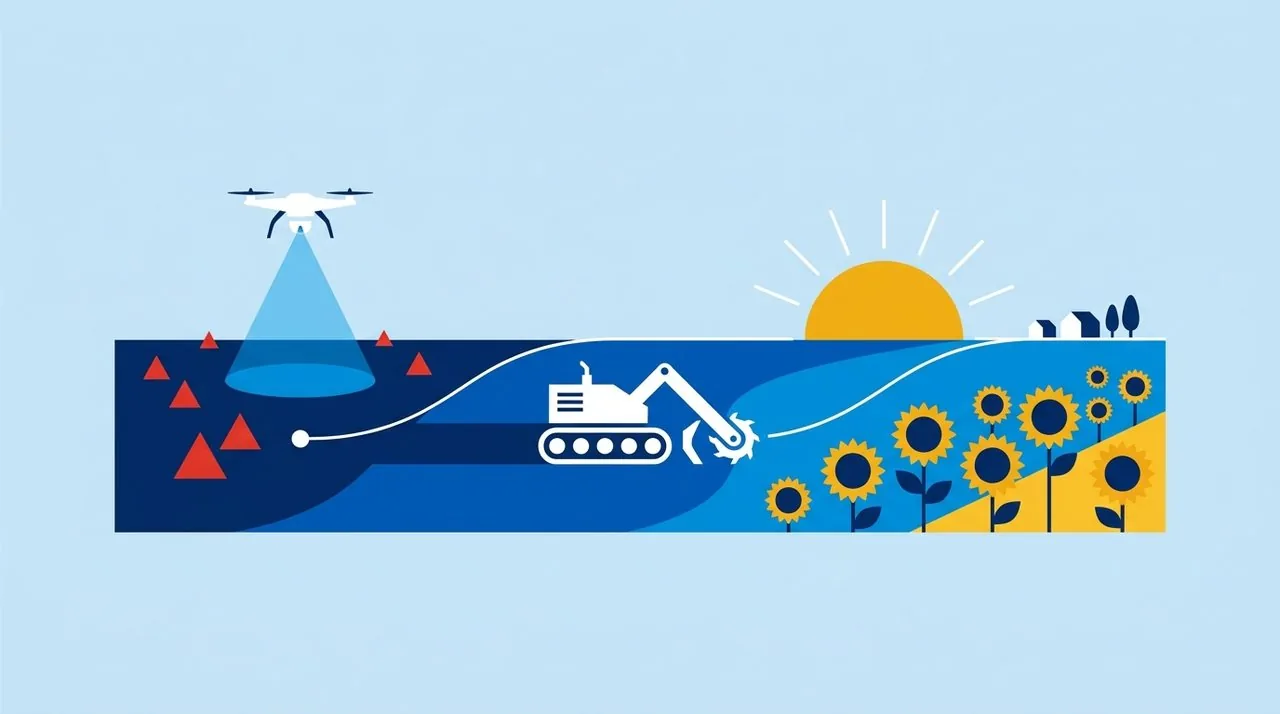
Clearing Ukrainian lands of explosive ordnance is the greatest humanitarian challenge in Europe since World War II, which will determine the pace of the country's recovery for decades to come.
As of 2026, the problem of mine contamination remains one of the most acute obstacles to returning to peaceful life in de-occupied and frontline communities. Humanitarian demining is a foundational stage of socio-economic recovery. Without safe land, it is impossible to rebuild infrastructure, return internally displaced persons, restore agricultural production, and attract investment. According to international institutions, the scale of the problem is unprecedented in the modern world, and the approach to solving it requires global consolidation of efforts, innovative technologies, and systematic planning.
The Scale of the Problem and Its Impact on Society
The total area of territories requiring survey and potential clearance equals the size of several European countries. This invisible barrier literally paralyzes the life of entire regions. The civilian population takes the hardest hit. People striving to return to their homes after de-occupation face deadly danger in their own yards, on roadsides, in forest strips, and on the banks of water bodies. The mine threat makes safe movement impossible, restricts access to medical and educational services, and limits opportunities to meet basic needs.
A separate tragedy is the impact on the agricultural sector. Ukraine, historically one of the guarantors of global food security, faces the reality that millions of hectares of fertile soil are out of circulation. Farmers in de-occupied communities cannot start sowing campaigns. Those who dare to go into the fields without an official demining certificate risk their own lives and the lives of their workers. According to experts, economic losses from idle agricultural lands amount to billions of dollars annually, directly hitting local budgets and the communities' ability to sustain themselves.
Resource Deficit and the Role of Technologies
In 2026, humanitarian demining faces a critical deficit of resources. The clearance process using classical methods (manual demining) is extremely slow and expensive. Training and certifying a single mine action operator takes months of preparation, while the need is measured in thousands of specialists. Furthermore, there is an acute shortage of heavy mechanized demining machines capable of safely and quickly traversing large areas of agricultural land.
Rapid technological development is becoming the answer to these challenges. Remote sensing of the earth using unmanned aerial vehicles (drones) equipped with multispectral and thermal imaging cameras allows for the detection of anomalies on the surface and in the topsoil. Artificial intelligence (AI) analyzes terabytes of visual data, identifying potential minefields and explosive remnants with high accuracy. This prevents wasting sappers' time on clean territories (so-called non-technical survey) and focuses efforts exclusively on confirmed hazardous areas.
Main Challenges of Humanitarian Demining in 2026
Despite the involvement of international aid and the implementation of innovations, the territory clearance process faces a number of systemic barriers. Solving these problems requires not only funding but also changes to the regulatory framework, standardization of processes, and deeper coordination among the state, international partners, and the non-governmental sector.
Shortage of Personnel and Equipment
The lack of certified sappers and the high cost of mechanized demining machines significantly slow down the pace of clearing large areas, especially in agricultural regions.
Agricultural Collapse
The blocking of millions of hectares of fertile land leaves farmers without work, destroys the economy of de-occupied communities, and threatens global food security.
Technological Barriers
Although drones and AI systems prove their effectiveness, their scaling, certification according to international standards, and integration into daily work require colossal investments.
Environmental Damage
Explosive ordnance and their detonation lead to toxic soil contamination with heavy metals and the destruction of local forest and aquatic ecosystems.
Independent or so-called "black demining" of agricultural lands by uncertified specialists poses a critical threat to civilian lives. Only official mine action operators can provide a safety guarantee and a cleared territory certificate.
Technologies will not replace a sapper in the field, but artificial intelligence and drones can reduce territory survey times by years, saving thousands of lives.Yellow-Blue Editorial Team
Forecast: Stages of Clearing Ukraine in the Post-War Decade
Assessing the scale of contamination, international and Ukrainian experts agree that the humanitarian demining process will take decades. The success of this mission will depend on clear prioritization. It is impossible to clear the entire territory at once, so the strategy for the post-war decade will be based on the gradual return of lands to safe use, starting from the most critical facilities to complex natural landscapes.
Immediate Stage: Critical Infrastructure and Housing
In the first years after the end of active hostilities, ensuring the basic livelihood of communities will become an absolute priority. The efforts of humanitarian missions will focus on demining power lines, gas pipelines, water mains, main transport routes, as well as residential areas, schools, and hospitals. The goal of this stage is to create the minimum necessary conditions for the return of the civilian population and avoid humanitarian disasters in de-occupied cities and villages.
Medium-Term Stage: Agricultural Lands and Logistics
The next step will be the large-scale clearance of agricultural lands. This is a key stage for the recovery of the national economy. Mechanized demining machines and drones for non-technical surveys will play the main role here. Priority will be given to lands with high economic potential and territories around populated areas. In parallel, the clearance of secondary roads and local infrastructure will take place to restore full-fledged logistics chains.
Long-Term Stage: Forests, Water Bodies, and Complex Terrain
The most prolonged and complex task will be clearing natural ecosystems: forests, swamps, riverbanks, and water areas. These territories require specific equipment (e.g., underwater drones) and special operator skills. Due to vegetation density, the use of traditional equipment is complicated here. During this period, access to many natural zones will remain restricted for the civilian population for their safety.
Continuous Monitoring: Residual Risk
Even after the official completion of the main demining phases, Ukraine will face residual risks. Individual explosive items can remain deep underground for years and be washed to the surface by groundwater or during construction work. This stage involves creating a rapid response system for isolated findings, continuous monitoring using satellite data, and ongoing educational work with new generations of Ukrainians.
Synergy of Technologies, Partnerships, and Society
Humanitarian demining of Ukraine is a marathon that requires endurance, a systematic approach, and continuous support. The experience of 2026 clearly demonstrates that this problem cannot be solved using classical methods alone. The future of mine action lies in the realm of innovations: from autonomous robotic platforms to complex artificial intelligence algorithms that analyze soil conditions. However, even the most advanced technologies cannot work without proper funding and international cooperation.
International partnerships, sharing experiences with countries that have already gone through post-war recovery, and attracting donor funds will remain critically important factors. At the same time, a huge responsibility falls on civil society and humanitarian charitable foundations. Their role is transforming: from targeted assistance to systemic investment in training civilian sappers, purchasing robotic equipment, supporting mine victims, and conducting large-scale information campaigns on mine risks.
Safe land is the foundation upon which the life, economy, and future of de-occupied communities are rebuilt.Yellow-Blue Editorial Team
The Yellow-Blue Charitable Foundation focuses its activities exclusively on the humanitarian aspects of overcoming the consequences of the war. The foundation's program covers area reconnaissance and marking of explosive ordnance, training of specialists, a geo-registry of hazardous territories, and informing civilians—primarily children.