
A safe physical space is the foundation for the psychological recovery of people who have lost their homes.
The destruction of familiar infrastructure leaves people without access to basic utility or administrative services. At the same time, the social ties that have shaped the identity of each individual community for years also disappear. When local libraries, cultural centers, educational hubs, and ordinary local cafes close due to destruction, residents of cities and villages, as well as internally displaced persons, find themselves in a deep vacuum of isolation. According to mental health experts, the loss of social context and a familiar circle of communication often becomes one of the hardest trials for people who have fled their homes or spent a long time under occupation. In such realities, a vital need arises to create new, safe focal points.
Modern public spaces take on the role of such stabilization centers. They provide warmth and a stable internet connection, offering the opportunity to charge a phone or contact loved ones. However, their main function is much broader than satisfying basic needs. They become hubs of life where the paths of locals, volunteers, social workers, lawyers, and psychologists cross every day. It is here, within these walls, that the seemingly invisible but absolutely continuous process of mending war-torn social fabrics, forming new acquaintances, and restoring trust in society takes place.
Anchors in times of total uncertainty
The initial request of visitors to public spaces usually has a purely practical nature. People come here to get legal advice on the procedure for restoring lost documents, learn about current humanitarian support programs, resolve issues with social payments, or use a stable connection for work or study. Behind these mundane actions lies a much deeper, often unconscious need—to be heard, understood, and accepted. Specialists who work daily in such spaces note a clear pattern: an ordinary, sincere conversation over a cup of hot tea often has no less therapeutic effect than a formalized specialized consultation.
For internally displaced persons, a social hub becomes a safe haven in a new, unfamiliar city. It is an environment free of prejudice, where anyone can share their painful experiences without fear of judgment or misunderstanding. Various joint activities organized in such centers—from creative workshops for children to mutual support groups or career guidance meetings for adults—create a strong sense of belonging to a group. Gradually, a temporary shelter turns into a cohesive community capable of independently generating initiatives, solving local problems, and taking its most vulnerable members under its wing. A process of soft integration occurs, where a person stops feeling like a stranger and begins to influence the life of the host community.
The Yellow-Blue Foundation works systematically to equip and support the operation of social hubs in de-occupied communities and regions hosting IDPs. We provide the spaces with the necessary equipment and create conditions for their uninterrupted functioning, as we believe that having a comfortable and safe meeting place is a critical prerequisite for the comprehensive psychological rehabilitation of those affected.
The architecture of trust and long-term recovery
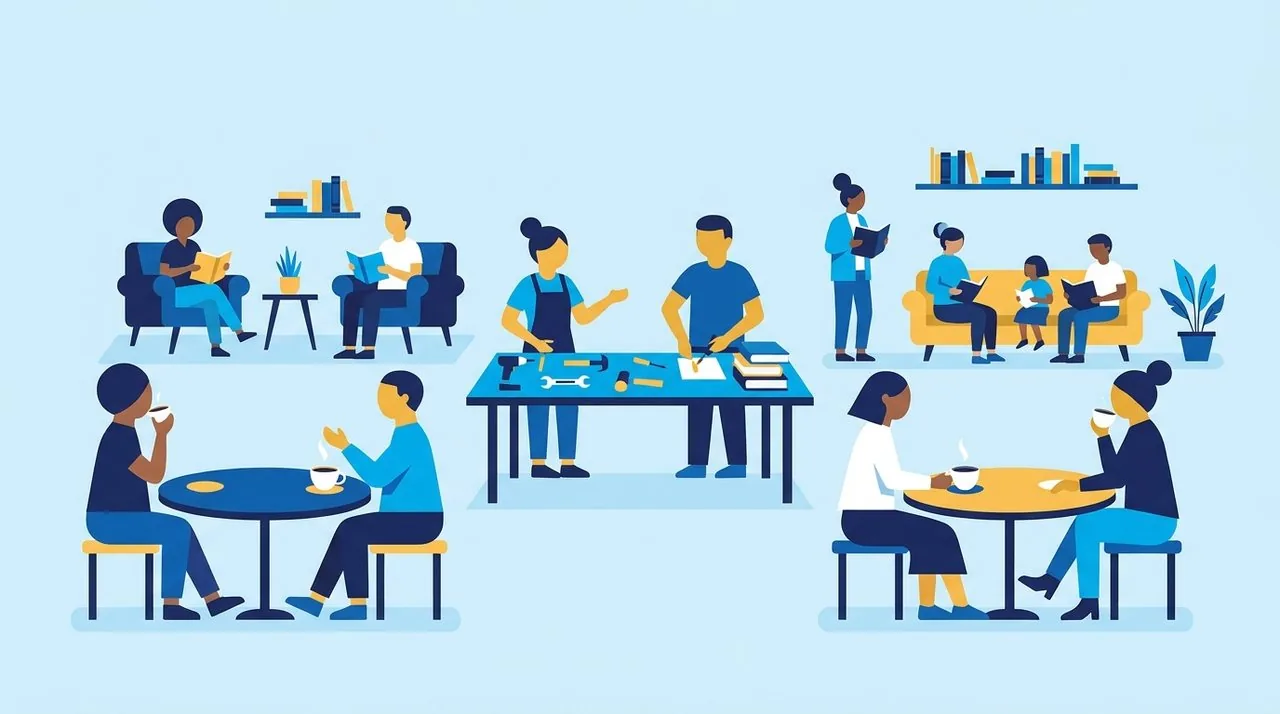
The physical space of a hub directly dictates the nature of interaction between people. Bright, warm, inclusive premises with thoughtful zoning, featuring places for both quiet private conversations and loud children's games, automatically relieve anxiety and promote openness. When a person who has lost their sense of security sees that their comfort has been taken care of down to the smallest detail, their level of basic trust in the environment grows rapidly. According to psychologists, this is an extremely important stage for those who have survived traumatic experiences, lost loved ones or property, and are therefore prone to deep self-isolation and depressive states.
An effective social space functions as a complex but well-coordinated living organism. In it, legal aid, social support, educational opportunities, and psychological support are provided comprehensively, complementing one another. According to humanitarian response experts, it is precisely this multi-component, integrated approach that demonstrates the best results in the long term. Instead of wasting resources looking for different specialists in different parts of an unfamiliar city, overcoming bureaucratic barriers, a person receives the entire spectrum of necessary help in one familiar, safe, and friendly place.
The true success of public spaces is not measured by the number of certificates issued or lectures held. It is measured by people's ability to gradually return to a full, active social life. Hubs become incubators for new local projects, where those who yesterday needed urgent help today become active volunteers, initiators of change, and opinion leaders in their renewed communities. They are not just rebuilding their lives—they are helping to rebuild the society around them.
The true value of a social space is measured by its ability to give people back a sense of home and community.Yellow-Blue Editorial Team