
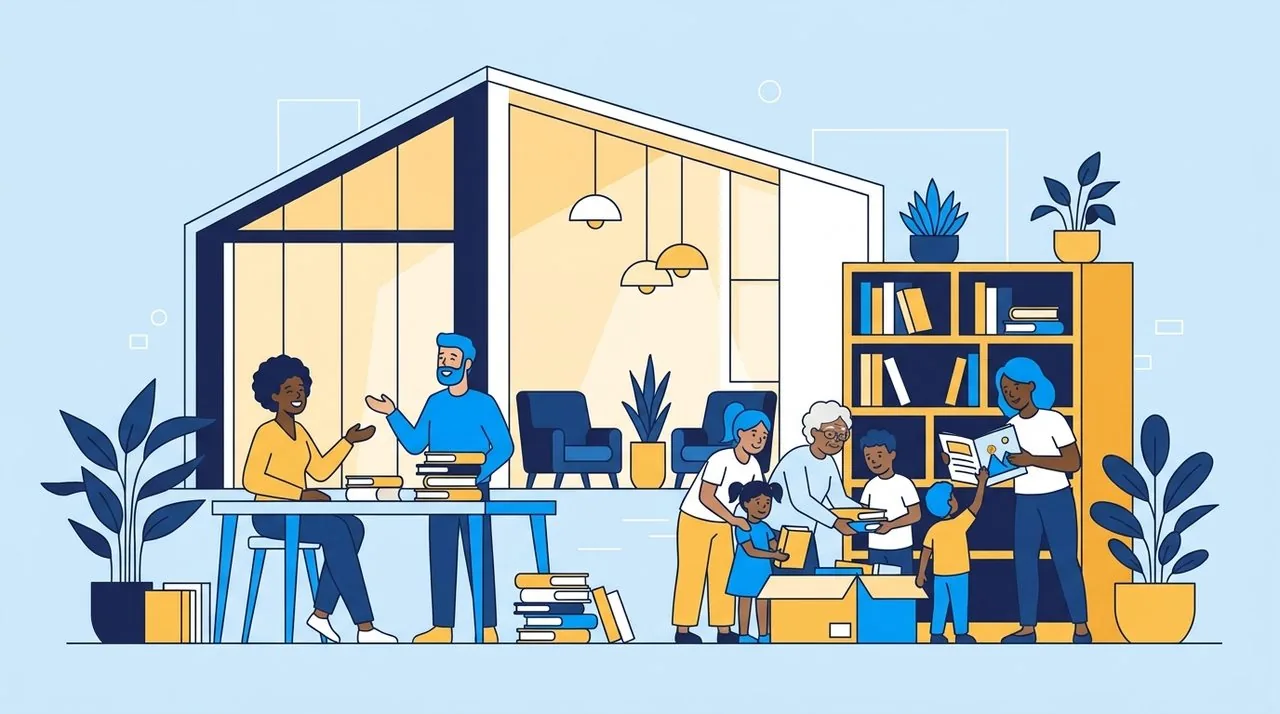
Successful adaptation of displaced persons requires overcoming social distance and creating safe spaces for interaction.
The scale of internal displacement due to hostilities remains unprecedented. Millions of people have been forced to leave their homes, seeking shelter in safer regions of the country. However, physical relocation is only the first step, albeit the most difficult one in terms of security. It is followed by a long, often invisible process of adaptation to a new environment, accompanied by a series of social, economic, and psychological challenges.
Upon arriving in new communities, internally displaced persons face basic needs: finding housing and sources of income. According to social policy experts, the real estate and local labor markets in host regions are often overloaded. This creates natural competition for resources, which, in the absence of competent communication, can transform into social tension between local residents and newcomers.
In addition to everyday difficulties, prejudices become a significant problem. Under stressful conditions, society is prone to stereotyping. The lack of direct communication sometimes leads to displaced persons being perceived solely through the prism of their status, rather than as professionals, neighbors, or active citizens. On the other hand, forced migrants themselves often feel guilt, anxiety over left-behind property, and a fear of being rejected, which forces them to isolate themselves in a narrow circle of people with similar experiences.
Such self-isolation is a natural defensive reaction to the trauma of losing a home. However, in the long run, it hinders full recovery and reintegration. A community in which parallel, disconnected social groups exist loses its potential for development and becomes vulnerable to internal conflicts.
From Isolation to Active Participation in Community Life
The process of transitioning from the status of a "temporarily displaced person" to a full-fledged member of a new community does not happen instantly. It is a journey that requires effort from both the individual and the host community. Humanitarian response experts identify several key phases of this process.
Stabilization and Settling In
At this stage, the focus is on meeting basic needs. A person looks for safe housing, sorts out documents, enrolls children in school or kindergarten, and tries to find a stable source of income. The psychological state is characterized by a high level of stress and disorientation. Interaction with the local population is usually limited to purely functional contacts: in a store, in government offices, or with landlords.
Social Thawing and Dialogue
When basic needs are partially met, the need for socialization arises. Displaced persons begin to explore the cultural and public spaces of the city or village. This is a critical moment when the attitude toward the new place is formed. It is here that platforms for informal communication play the most important role, where one can meet local residents, share experiences, and see each other as ordinary people, not status bearers. The destruction of initial stereotypes takes place.
Co-creation and Taking Root
The highest level of adaptation occurs when a person begins to feel responsible for the community in which they live. Internally displaced persons initiate their own projects, open local businesses, and join volunteer initiatives on a par with local residents. Mutual enrichment takes place: new people bring new ideas, professional skills, and cultural characteristics. The community becomes stronger through diversity, and displaced persons gain a new sense of home.
For the transition between these stages to happen smoothly, the mere availability of jobs or housing is not enough. Social infrastructure—so-called "third places"—is critically necessary. These are neutral, safe spaces that are neither home nor work, where people can gather voluntarily, communicate, learn, or simply relax.
The absence of such spaces preserves the problem. If people have nowhere to meet in an informal setting, they continue to live in their informational and social bubbles. Creating shared platforms allows shifting the focus from what divides (different experiences, backgrounds) to what unites: common interests, hobbies, caring for children, or the desire to improve the neighborhood's amenities.
The Yellow-Blue Foundation is actively working to overcome social distance by creating a network of social hubs in host communities. We open special spaces that become centers for interaction, psychological relief, and soft adaptation. In these hubs, internally displaced persons and local residents have the opportunity to communicate safely, participate in joint events, and form new social ties. Our goal is to provide tools for building a cohesive community where everyone feels supported.
Integration is always a two-way street. It requires empathy and a readiness for dialogue from all participants in the process. Supporting initiatives aimed at bringing people together, creating communication centers, and providing psychological help is an investment in the stability of society. When we help a person find new friends and feel like part of a community, we take a step toward restoring the social fabric that was damaged by the displacement crisis.