
Natural curiosity makes children extremely vulnerable in areas where hidden threats remain.
The return of families to de-occupied communities or living near areas that have suffered intense shelling poses a difficult challenge for adults. Ensuring a child's physical safety in conditions where danger can hide in the grass, on the shoulder of a familiar road, on a riverbank, or even in an abandoned playground requires much more than simple supervision. According to experts, a significant portion of accidents involving civilians occurs precisely due to a lack of knowledge about what explosive objects look like and how to act when they are found. The scale of territory contamination is such that this problem will remain relevant for several generations, which means that basic mine safety rules must become an integral part of upbringing.
Child psychology is wired in such a way that the world is perceived through active exploration. For a child, an abandoned building is an ideal place for adventures, thick bushes are a space for hide-and-seek, and an unknown metal object of an unusual shape is a potential toy or trophy. Traditional methods of informing, which more or less work with adults, often prove ineffective when it comes to schoolchildren. Strict prohibitions without detailed explanations are quickly erased from memory. On the other hand, constant warnings about mortal danger, reinforced by scary stories, can cause excessive anxiety, sleep disturbances, or, conversely, provoke a defensive reaction in the form of completely ignoring any rules.
The educational process in the field of mine safety requires a delicate, meticulous balance. Educators and parents need to provide comprehensive information about the risks, but at the same time preserve a sense of a normal childhood and not traumatize the psyche, which is already constantly under the pressure of external circumstances. That is why specialists from specialized humanitarian organizations are categorically moving away from the format of classic scare-tactics lectures, developing new approaches adapted to age characteristics.
Natural curiosity
The desire to explore the surrounding world outweighs the feeling of fear. Children often deviate from safe routes in search of new places to play, exposing themselves to danger.
Deceptive appearance
Modern ammunition can have an atypical shape, bright color, or resemble household items, which attracts attention and provokes the desire to pick them up.
Fatigue from prohibitions
Under conditions of prolonged stress, children get used to constant restrictions from adults, causing critical warnings to be perceived as background noise.
Lack of skills
Theoretical knowledge of the rules does not guarantee their implementation. In a stressful situation, a child may get confused if the algorithm of actions is not brought to automatism through practice.
From theory to sustainable behavioral habits
The paradigm shift in mine safety training consists of moving from passive information consumption to active interaction. For the rule "do not approach, do not touch, inform adults or call 101" to work in a real critical situation, it must become a reflex. Achieving this level of memorization is easiest through tools that are organic to a child—play, situation modeling, solving logical tasks, and involving familiar characters.
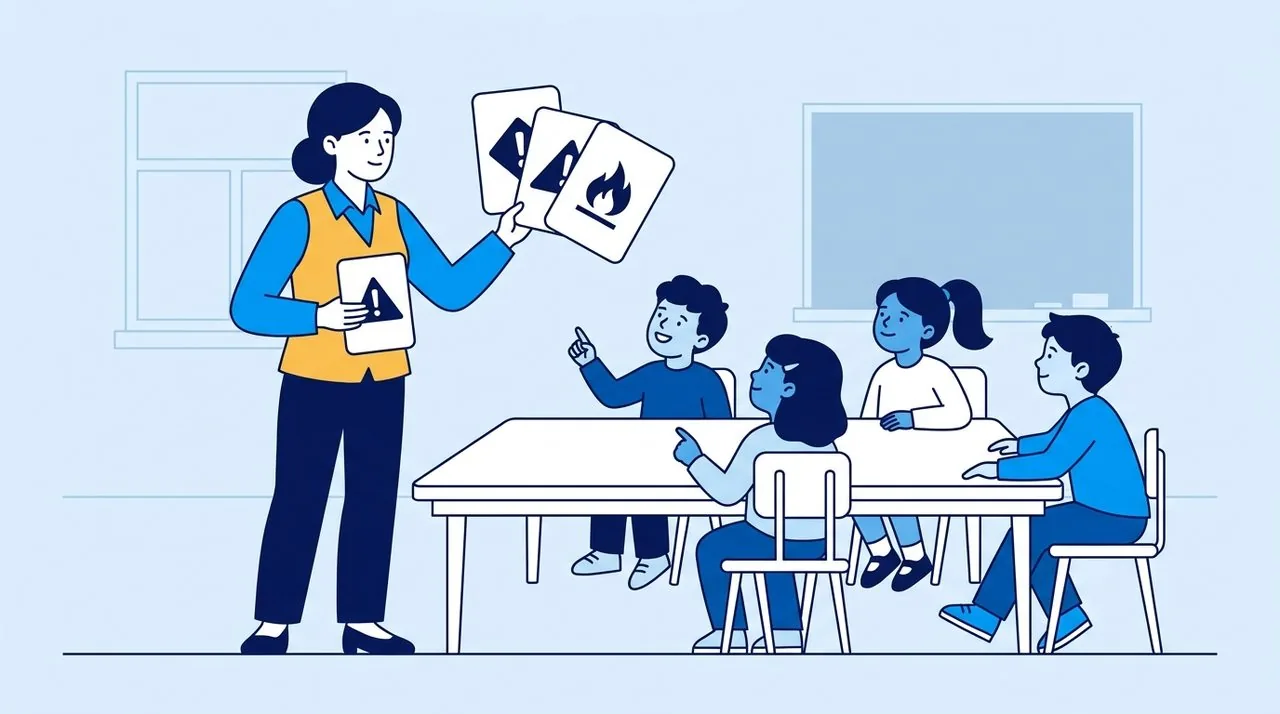
Working with different age groups requires radically different tools and tonality. For primary school students, interactive classes with gamification elements prove to be the most effective. When safety rules are explained by a friendly animated character, or when children work in teams solving riddles on special illustrated cards, complex information is absorbed without internal resistance. Teenagers, due to their natural tendency to question adult authority, need a reasoned conversation. For them, discussion formats, analysis of modeled situations, and a "peer-to-peer" approach work well, where high school students, after appropriate training, become safety ambassadors for their peers themselves.
An important component of successful learning is also working with the child's environment. Often adults, being in a state of chronic stress, project their own anxiety onto children, making the process of exploring the world even more tense. Therefore, high-quality educational initiatives always include providing methodological support to teachers and parents, helping them communicate correctly about risks without falling into extremes between panic and negligence.
The Yellow-Blue Foundation is actively working on building a safety culture in Ukrainian communities. Understanding the scale and duration of the challenges associated with territory contamination, we develop and implement comprehensive civilian awareness programs, focusing specifically on the most vulnerable category—children. Our specialists regularly conduct special game-based mine safety trainings for schoolchildren of different age groups. During such classes, the most comfortable and safe environment is created. Students have the opportunity to discuss their fears, ask any questions, and practice, through role-playing games, the response algorithms for discovering suspicious objects.
The Yellow-Blue Foundation's training programs strictly adhere to humanitarian informing standards. We deliberately avoid shock content and demonstrating the real consequences of accidents. Instead, the focus remains on developing attentiveness, the ability to recognize danger markers, and reinforcing correct behavioral patterns.
Integrating such trainings into the regular educational process helps remove the psychological stigma from the topic of mine danger. It ceases to be something taboo or exclusively paralyzing. Instead, children receive a specific, understandable set of tools that returns to them a sense of control over their own safety. They learn to notice official and homemade warning signs, realize why it is critically important not to step off paved roads during nature walks, and most importantly—they train the skill of proper communication with emergency services.
The effectiveness of the humanitarian demining process is measured not only by the number of neutralized munitions and the area of cleared land, but also by the number of averted tragedies. The educational direction plays a parallel, fundamental role here. While sappers step by step survey hectares of territories, the civilian population must possess the knowledge for safe coexistence with existing risks. Systematic training of children in the basics of mine safety is an investment in saving the lives of an entire generation.
A child's safety begins where a strict prohibition turns into an understandable and automatic algorithm of actions.Yellow-Blue Editorial Team